
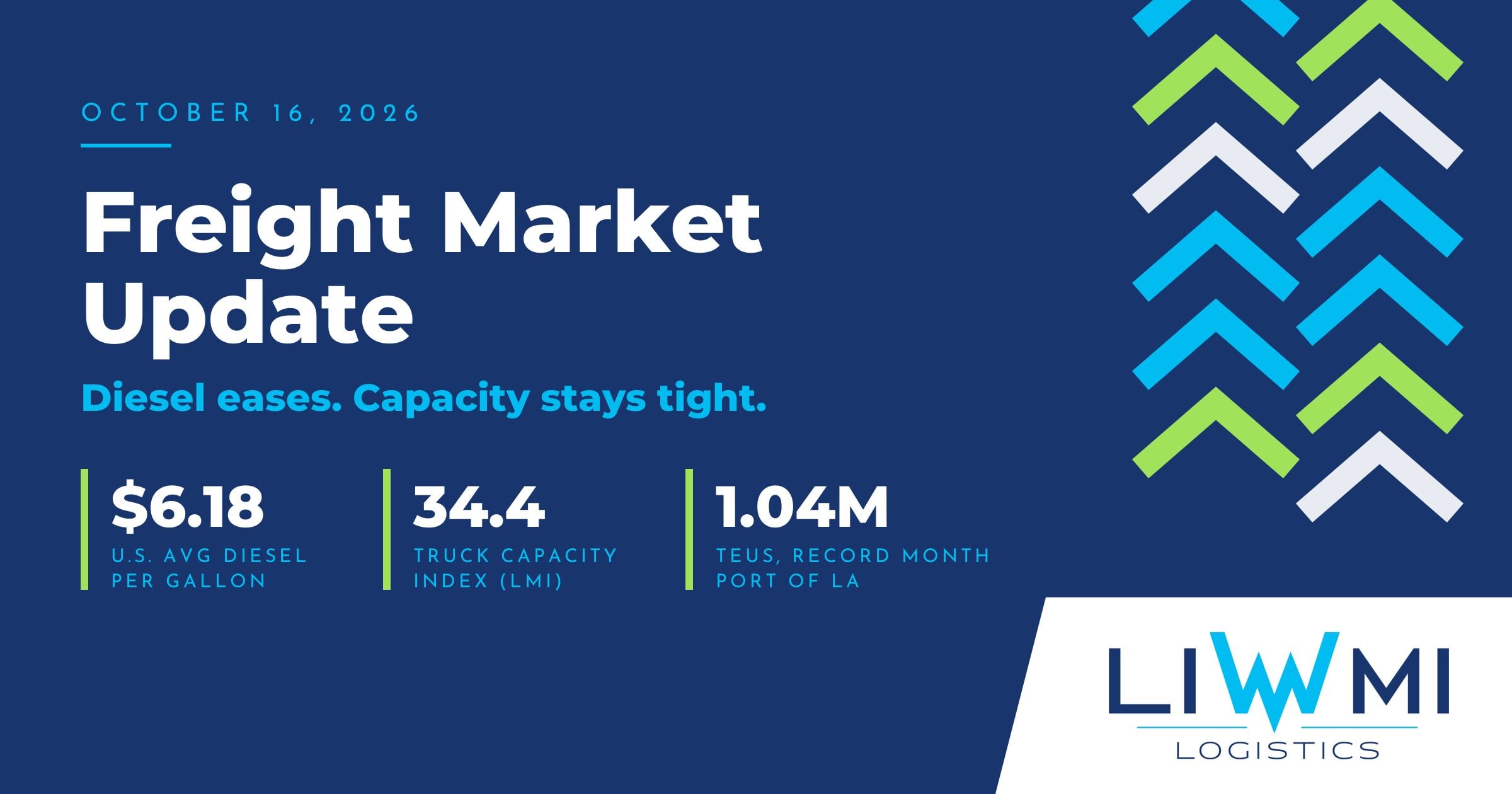
Diesel is finally easing, but it still costs more than $2.50 a gallon more than it did a year ago. Truck capacity kept shrinking in September, and the Port of Los Angeles just had the busiest month in its history. Put together, this is a market where shippers who plan early win.
What’s happening with diesel prices?
The U.S. average for on-highway diesel was $6.179 a gallon for the week of October 12. That’s 2 cents lower than the week before and about 35 cents below the $6.529 reading for the week of September 21. It’s still $2.514 higher than a year ago.
Source: EIA Gasoline and Diesel Fuel Update, released Oct 14, 2026; EIA weekly diesel history
Prices vary widely by region:
- California: $8.091, the highest in the country
- Midwest: $6.259
- Gulf Coast: $5.809
- Lower Atlantic: $5.645, the lowest in the country
Source: EIA, week of Oct 12, 2026. Next EIA update: Oct 20.
Is truck capacity tight right now?
Yes. The Logistics Managers’ Index (LMI) puts transportation capacity at 34.4 for September, down from 40.0 in August. Any reading under 50 means capacity is shrinking, and this is the tenth straight month of contraction.
Transportation prices rose to 92.7 from 90.0, inventory levels climbed to 58.9 from 52.8, and warehouse capacity fell to 39.3 from 53.5. Survey respondents expect capacity to stay in contraction over the next 12 months, with a predicted reading of 37.9.
Source: Logistics Managers’ Index, September 2026, released Oct 6, 2026
What’s moving through the ports?
The Port of Los Angeles handled 1,042,652 TEUs (twenty-foot equivalent units) in September, the busiest month in its 118-year history. Loaded imports reached 545,696 TEUs, up 19% from last September, and loaded exports rose 10%. Through nine months the port has moved nearly 8.1 million TEUs, more than 3% ahead of last year.
The port credited resilient consumer demand, importers restocking inventory, lower tariffs and cargo shifting away from the Suez and Panama Canal routes.
Source: Port of Los Angeles news release, Oct 9, 2026
Any storms or disruptions to watch?
The Atlantic was quiet as of Friday afternoon, October 16, with no tropical cyclones. In the Eastern Pacific, Hurricane Trudy is off Mexico’s southwest coast and Tropical Storm Simon is near southern Baja California. Atlantic hurricane season runs through November 30.
Source: National Hurricane Center, Oct 16, 2026
What’s on the freight calendar?
- Friday, Oct 30: last business day of the month, which usually means a month-end shipping push
- Wednesday, Nov 11: Veterans Day, a federal holiday
- Thursday, Nov 26: Thanksgiving, with a shortened holiday week for shippers and receivers
- Monday, Nov 30: Atlantic hurricane season ends
The LIWMI Take
Cheaper fuel is good news, but it won’t loosen the market on its own. Capacity is shrinking, inventories are building and record imports are landing on the West Coast. That combination makes carriers choosy and leaves freight with tight delivery windows little room for error.
We don’t expect a quick turnaround. The logistics managers in the LMI survey don’t either. The shippers who come out ahead this quarter will be the ones who plan before the holiday rush instead of during it. Our team is ready to roll up our sleeves and keep your customer promises on schedule.
What shippers should do now
- Tender loads earlier than usual, especially anything with a firm delivery appointment.
- Lock in Thanksgiving-week pickups and deliveries now, before holiday capacity tightens.
- Check your fuel surcharge tables against this week’s EIA numbers.
- For import containers, line up drayage before the box arrives at the port.
- Build a buffer day into any shipment where a late delivery costs you a customer.
Frequently asked questions
How often are diesel prices updated?
EIA publishes U.S. diesel prices weekly. The next release is Tuesday, October 20, 2026.
What does a capacity reading below 50 mean?
In the Logistics Managers’ Index, a reading above 50 means something is growing and a reading below 50 means it’s shrinking. September’s capacity reading of 34.4 means fewer available trucks relative to demand.
Will freight rates drop now that diesel is falling?
Fuel surcharges usually follow diesel prices quickly. Base rates depend more on capacity, and surveyed logistics managers expect capacity to stay tight over the next year.
How early should I book Thanksgiving freight?
As early as you can. With capacity already shrinking, waiting until Thanksgiving week to book raises the risk of missed pickups and higher spot rates.
Have freight that can’t be late? Get a quote or book a 15-minute freight review with our team.
Sources
- U.S. Energy Information Administration, Gasoline and Diesel Fuel Update, released Oct 14, 2026
- U.S. Energy Information Administration, Weekly U.S. No. 2 Diesel Retail Prices, accessed Oct 16, 2026
- Logistics Managers’ Index, September 2026 Logistics Managers’ Index, released Oct 6, 2026
- Port of Los Angeles, Port of Los Angeles Sets All-Time Monthly Cargo Record, Oct 9, 2026
- National Hurricane Center, Tropical Weather Outlooks, Oct 16, 2026